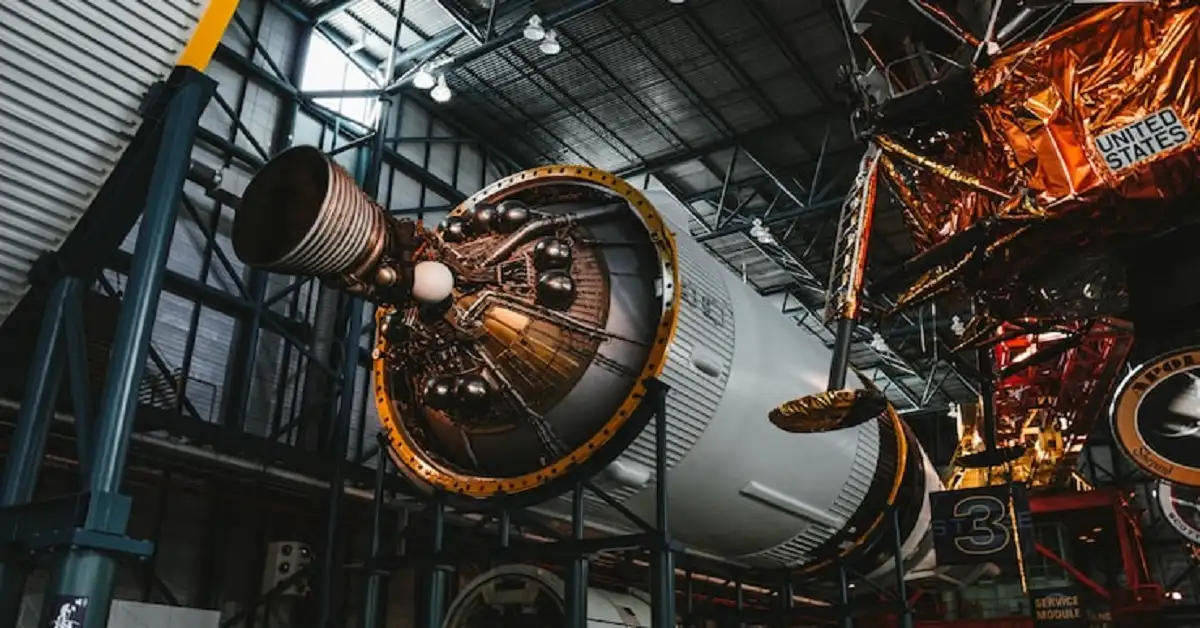
If you look at the engines that powered the Saturn V rocket during the Apollo era, they are masterpieces of industrial geometry. They are defined by straight lines, perfect cylinders, welded pipes, and distinct, bolted-on boxes. They look exactly like what they are: machines designed by humans using slide rules and built by machinists using lathes.
But if you look at the combustion chambers and nozzles of the latest generation of commercial rockets, something has changed. The geometry has become unsettlingly organic. The rigid pipes are gone, replaced by vein-like channels that twist and bulge. The structural supports don’t look like steel beams anymore; they look like the trabecular lattice of a bird’s bone.
To the uninitiated, these components look alien, or perhaps biological. They look less like they were assembled in a factory and more like they were grown in a petri dish.
This aesthetic shift is not an artistic choice. It is the visible result of a quiet revolution in engineering where the “Designer” is no longer a human, but an algorithm, and the “Builder” is no longer a cutter, but a grower. We are witnessing the end of the “Design for Manufacturing” era and the dawn of the “Design for Performance” era.
The Tyranny of the Machinist
For the last century, aerospace engineering was held hostage by the limitations of the tool bit. An engineer might dream of a perfectly optimized fuel bracket, but if a 3-axis CNC machine couldn’t cut it, or a mold couldn’t release it, the design had to change.
Engineers were forced to think in primitives: blocks, holes, and cylinders. They had to add excess weight to accommodate bolts and flanges. They had to design cooling channels that were straight because you cannot drill a curved hole through a block of metal. Every rocket engine was a compromise between what the physics demanded and what the factory could actually produce.
Enter the Algorithmic Engineer
The strange, organic shapes we see today are the result of Generative Design.
In this workflow, the engineer stops drawing the part. Instead, they tell the computer the problem. They input the parameters: “I need a bracket that connects Point A to Point B, withstands 50,000 Newtons of force, resists 500 degrees of heat, and weighs as little as possible.”
The software then runs a simulation that mimics millions of years of evolution in a few hours. It generates thousands of iterations, testing and discarding them. It adds material where stress is high and removes it where it is unnecessary.
The computer does not care about straight lines or symmetry. It cares only about the math. The result is almost always a structure that mimics nature. Nature, after all, is the ultimate optimizer. Trees add thickness only to the branches that bear weight; bones are dense only where the load is heaviest. The software arrives at these same biological conclusions, creating “bionic” shapes that are 40% lighter and 20% stronger than their human-designed predecessors.
The Cooling Paradox
The most dramatic application of this is visible in the combustion chambers of liquid rocket engines.
A rocket engine is essentially a controlled explosion. To keep the metal chamber from melting, engineers pump cryogenic fuel through channels in the wall of the chamber before injecting it into the fire. This is regenerative cooling.
Traditionally, building these cooling channels was a nightmare. It involved brazing hundreds of individual small tubes together or machining channels into a copper liner and wrapping it in a structural jacket. It was heavy, leak-prone, and expensive.
With modern additive methods, engineers can now “grow” the combustion chamber wall with the cooling channels already inside it. Because they aren’t restricted by a drill bit, these channels can spiral, branch, and change diameter to optimize coolant flow at the hottest points of the throat. The vein-like ridges seen on the outside of modern engines are often the external contours of these internal, complex vascular systems.
The Part Consolidation Revolution
The “biological” look also stems from the fact that modern engines are no longer collections of parts—they are singular organisms.
In the past, an injector head might have been an assembly of 100 different pieces—plates, posts, screws, and O-rings. Each connection was a potential failure point. Each seal was a potential leak.
Today, that same injector head is grown as a single, monolithic unit. The complex swirling passages for fuel and oxidizer are printed directly into the structure. This is known as “part consolidation.”
We have seen instances where aerospace companies have taken an assembly of 300 distinct parts and replaced it with one printed component. This doesn’t just reduce weight; it eliminates the supply chain headache of sourcing 299 other parts. It creates a component that is more robust because it has no seams to burst.
The Freedom of “Addiction”
This revolution is powered by the transition from subtractive to additive manufacturing. Subtractive manufacturing (milling) is like carving a statue from stone; you are limited by the accessibility of your chisel. Additive manufacturing is like painting a picture; you can place a pixel of material anywhere you want, layer by layer.
This capability has finally allowed engineers to physically realize the complex, optimized topologies that their software imagines. The machine doesn’t care if the shape is a simple cube or a complex lattice that resembles coral; the effort to print it is the same.
The Future is Organic
As we look toward the future of flight—whether it is hypersonic travel, deep-space exploration, or urban air mobility—the machines will look increasingly less like “machines.”
The rigid, industrial, blocky aesthetic of the 20th century was a reflection of our limitations. We built in boxes because boxes were easy to build. Now that the shackles of traditional tooling have been broken by 3D printing for aerospace, the vehicles of the future will return to the logic of the natural world.
They will be skeletal, vascular, and seamless. We are entering an age where we no longer hammer metal into submission; we encourage it to evolve into the most efficient shape possible. The rocket of tomorrow will not look like it was built by a carpenter, but rather like it was forged by millions of years of evolution.